The Soft Threshold: Making the First Few Feet of Home a Kinder Place to Land
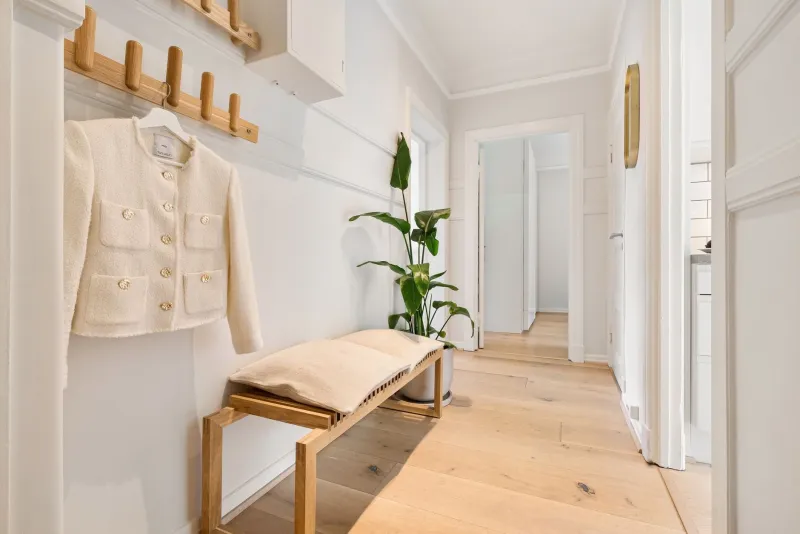
You know the feeling. The door closes behind you, the bag slides off your shoulder, and within seconds the hallway has become a holding pen. Shoes everywhere. A letter half-trodden into the mat. Keys somewhere in the coat pocket you swore you checked. Nothing terrible has happened, but the space has already told you that you are behind.
Hallways are funny things. We tend to treat them as plumbing for the home — a corridor to get from the front door to the kettle — rather than a room that does emotional work. But the first few feet inside your home are a threshold. They catch you between the outside version of yourself and the softer one who is allowed to put things down. Getting that bit slightly more right is not about showroom tidiness. It is about being received.
The bit of the house that sees you first
Think about what your entryway says before you have said a word. A dark pile of trainers says rush. A stack of unopened post says admin. A bare wall and a hard floor can say nothing at all, which is its own kind of unwelcoming. None of this is a moral failing. It is just information.
A soft landing does not require a boot room, a bench with wicker baskets, or a hallway that looks like a cottage in a magazine. Most of us are working with a narrow Victorian corridor, a rented flat with a communal stair, or a front door that opens almost directly into the living room. The point is not to solve the hallway. The point is to give the first few feet a job that feels kind.
Start with what your hands are doing
When you walk in, your hands are usually full. Keys, post, a bag, maybe a coat you are already shrugging off. The simplest hallway improvements come from asking one question: where can these things land without me having to think?
A small tray for keys by the door. A lidded box or basket for post. A single hook at the right height. These are tiny moves, but they reduce the little moment of friction that turns arrival into a low-level task. You are not being tidy for guests. You are being tidy for the version of you who will walk back in at 6pm with wet shoes and no patience.
Shoes: a place to land, not a pile to solve
Shoes are the great hallway test. In the UK, we spend a lot of the year bringing in weather, so it helps to have one deliberate spot for the pairs that are in use this week. A shallow tray, a sturdy basket, or a freestanding shoe rack works well. If you rent and cannot drill, look for over-door hooks, tension rods, or a slim rack that tucks under a coat rail. None of it needs to match. It needs to be easy enough that you will actually use it on a dark Tuesday.
Try to keep the landing spot small. A tray for two or three pairs is a boundary. A sprawling pile is not a system; it is a small indoor weather event. If family members are involved, the aim is not perfect compliance. It is a shared place where the most-worn shoes go, so the rest of the floor can stay clear.
Give the post somewhere to wait
Unopened post has a way of spreading. It starts by the door, then it is on the kitchen counter, then it is somehow on the stairs. A lidded box or a simple document tray gives post a waiting room. You do not have to open it at the door. You just have to stop it from becoming part of the floor.
If you have a household with more than one adult, this is also a quiet way to share the mental load. One named box for the boring letters, one for things that need action, and a weekly five-minute sort is usually enough. The hallway does not need to become an office. It just needs one place where paper can pause.
Keys, coats and the art of the single hook
Keys are small, which is why they cause disproportionate chaos. A bowl on a shelf, a hook by the door, or a little dish on top of a shoe cabinet can all work. The trick is to choose one spot and let it be the spot. Not the kitchen drawer, not the coat pocket, not the bottom of the bag. One place, consistently, so your hand learns it.
Coats are similar. A row of hooks can be brilliant, but only if there is breathing room. If the hallway is tight, a single over-door hook for the coat you are actually wearing can be enough. The rest can live in a wardrobe. A hallway does not have to hold everything to feel calm. It just has to hold the things you need in the next twelve hours.
The five-minute evening reset
This is the gentle bit. At some point in the evening — before bed, after supper, whenever you remember — spend five minutes at the door. Not cleaning the whole hallway. Just resetting the threshold.
Put the shoes you wore today into their tray or basket. Put the post in its waiting place. Hang the coat that got dumped on the back of a chair. Straighten the mat. If there is a surface, wipe it once. If a bag is blocking the door, move it. That is it. Five minutes, no deep clean, no bin bag unless you genuinely want one.
The magic is not in the perfection. It is in the fact that tomorrow-you will open the door and meet a space that has been left ready. A small kindness, done in advance.
The point is not a perfect hallway
There will still be days when the hallway looks like a parcel depot and you cannot find your keys. That is fine. A soft landing is not a permanent state; it is a direction of travel. The first few feet of home can be a place that says, quietly: you can put your things down now. You are here.
Start with one thing — the keys, the shoes, the post — and let the hallway become a little more forgiving. It is not the whole house. It is just the threshold. But thresholds matter more than we tend to admit.