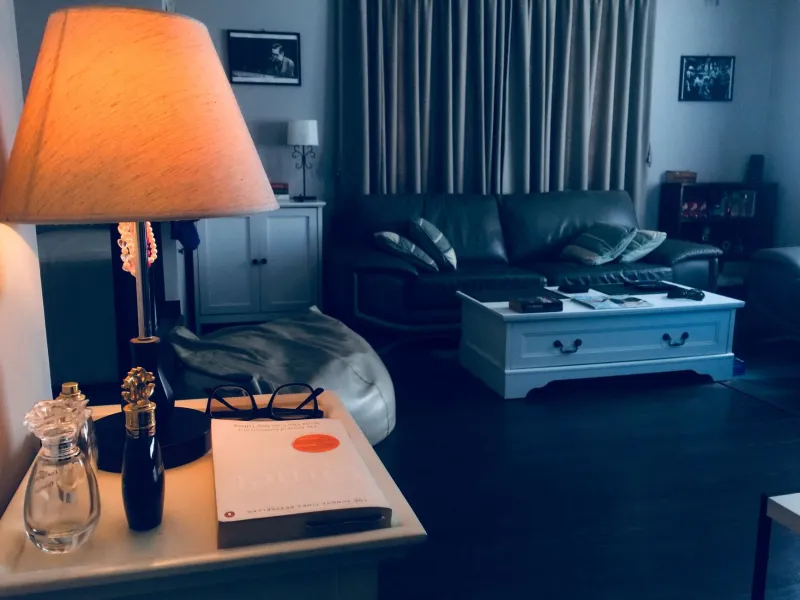
Side by Side, No Script: The Quiet Company of a Shared Evening

There is a certain kind of November evening in the UK. The dark arrives before you have decided what is for tea, the radiator clicks, and the sofa starts to look less like furniture and more like a small country you would like to emigrate to. On those evenings, the best company is often not a big conversation or a planned activity. It is someone else in the room, doing their own thing, asking nothing of you.
That is the parallel evening: a stretch of time when two or more people share a space without performing for each other. One reads. One knits. One scrolls. A child draws at the coffee table. The dog occupies more of the blanket than anyone agreed to. Nobody is hosting. Nobody is being hosted. You are simply alongside each other, and that is the whole plan.
What makes it different from just being in the same room
Plenty of homes have people in the same room while everyone is somewhere else entirely. The parallel evening is not about proximity by accident. It is a small, deliberate pause where the shared room becomes a soft base camp rather than a stage.
The key is low demand. There is no need to fill the silence, produce a funny story, or prove you are having a lovely time. You do not have to match anyone’s mood. You can be a bit flat, a bit distracted, a bit quiet. The other person can be the same. The evening still counts.
This is not the same as distance. Distance is when silence feels like a closed door. Parallel company is when silence feels like an open room. The difference is usually tiny and mostly felt: a glance, a shared sigh at the weather, a cup of tea placed within reach, a foot nudging yours under the blanket.
Why it takes the pressure off
Home can quietly become a place where we feel we ought to be entertaining, improving, or organising. Even rest can start to feel like a task with a standard to meet. A parallel evening interrupts that. It says, for an hour or so, that being present is enough. You do not have to be interesting. You do not have to be productive. You just have to be there.
For couples and flatmates, this can be a relief. Not every evening needs to be a date, a deep chat, or a summit meeting about bins and milk. For children, sitting near a grown-up who is calmly occupied can be settling without any direct attention being demanded. For pets, it is often the ideal arrangement: company without conversation.
There is also something gently regulating about shared stillness. The nervous system does not need a lecture. It needs cues: a familiar lamp, the rustle of pages, someone breathing steadily nearby, the clink of a mug. These small signals tell the body that the evening has landed and there is nothing to chase for a while.
How to make a parallel evening without making it a project
Keep it loose. The moment it becomes a scheduled wellbeing initiative with a start time and a success criteria, it will start to feel like homework.
Choose the least demanding room
The living room is the obvious choice, but it could be the kitchen table, a bedroom with a chair, or the end of the sofa nearest the radiator. The room should be warm enough to sit still in and not so tidy that someone feels they ought to be cleaning it.
Give it a soft window rather than a rule
Try twenty minutes after tea, or the stretch between clearing plates and the next thing. You are not blocking out the whole evening. You are making a small pocket where nobody has to be on duty.
Bring something that occupies your hands
A book, knitting, a puzzle, a phone game with the sound off, a magazine, a sketchbook. The activity is not the point. It is a gentle excuse to stop face-forward and let the room be shared rather than managed.
Let separate attention be allowed
You do not have to narrate what you are reading or ask what the other person is doing every four minutes. A parallel evening can include conversation, but it does not require it. The odd comment is lovely. Constant commentary turns it back into a performance.
Include children and pets without making it a circus
A child can draw beside you, build something small, or listen to an audiobook. A pet can settle nearby. The aim is not family fun time with activities. It is the quieter message: we are all here, and nobody has to earn their place on the rug.
Silence together is not the same as distance
It is worth saying plainly: comfortable silence has to be comfortable. If the quiet in your home feels tense, prickly, or punishing, a parallel evening will not fix that on its own. It may even amplify it.
You can test the temperature with a very small sentence. Something like, I am here, just quiet. Or, I am not ignoring you, I am just knitting. Or even, do you want company or space? These tiny clarifications stop silence from being read as rejection.
For some people, silence was used as a weapon growing up. For others, it was the only calm available. It makes sense that sharing quiet can feel complicated. Go gently. You are allowed to start with five minutes, not a whole evening.
A small invitation for tonight
If the dark is already at the windows and the kettle is making its familiar noise, try a parallel evening. Same room. Low lights. Something in your hands. No agenda beyond being nearby. You do not need to say much. You do not need to make it nice. You just need to let the quiet be a shared thing rather than a lonely one.
Sometimes the most nurturing thing a home can offer is not a conversation, a plan, or a perfectly arranged evening. It is the simple, unglamorous comfort of someone else in the room, entirely at ease with you doing nothing much at all.