The Off Switch You're Allowed to Use: A Kinder Relationship With Background Noise
It's half past four on a November afternoon and the light has already given up. The kettle's been on twice. And somewhere in the background — the kitchen, the hallway, the corner of the living room where the speaker lives — something is playing. Not because you chose it, exactly. More because the alternative was a house that made no sound at all, and at this time of year that felt like a lot to ask.
If that sounds familiar, you're in very good company. Most of us don't decide to fill our homes with noise. We just never quite get round to switching it off.
The sound you didn't consciously pick
Think about the last time your home was properly silent. Not asleep-silent, not everyone's-out-silent. Just quiet, with you in it, awake.
For a lot of people the answer is: I can't remember. The radio goes on with the first cup of tea and stays on through the washing up. The podcast fills the school run and then the laundry and then, somehow, the whole of Tuesday. Background noise has become the default setting of the British home — a sort of acoustic wallpaper we stop seeing, or rather hearing, altogether.
None of this is a moral failing. It's just what happens when sound is free, endless and one tap away.
What the radio is actually doing for you
Here's the part worth saying plainly: the noise is not nothing. It's usually doing a job.
For people who live alone, a voice in the room can take the hard edge off an evening. For anyone working from home, the murmur of a station they half-listen to can mark the difference between the working day and the rest of it — a kind of audio boundary. For plenty of us, sound is company, or reassurance, or simply proof that the world is still out there.
There's also the cover it provides. A house with the radio on is a house where you can't hear yourself think too loudly. If your mind has a tendency to circle, background noise is a very effective way of drowning out the circling. That's not silly. That's a sensible, self-protective move.
So this isn't an argument for throwing the DAB radio in a skip. It's an invitation to notice which job the sound is doing — and whether it's still the job you need.
Silence and loneliness are not the same thing
The reason many of us reach for the dial is that quiet gets confused with being on our own. And in November, with the dark arriving before the news, that confusion is very easy to make.
But they're different things. Loneliness is about connection. Silence is about acoustics. A house can be quiet and full of warmth — the boiler ticking, a neighbour's gate, rain on the bin lid. And a house can be noisy and still feel miles from anyone.
Worth remembering, too: silence has a reputation problem. We talk about it as though it's empty, or awkward, or something to be got through. Most of the time it's simply the room before anything else happens.
A low-pressure experiment (no gold stars)
If you fancy testing the water, here's the whole thing, and it takes no equipment and no discipline whatsoever.
Pick one ordinary moment this week — the ten minutes after you make a brew, say, or the bit between finishing work and starting supper. Leave the sound off for it. Not for an hour, not as a challenge, not for a streak you'll feel guilty about breaking on Thursday. Just one small window.
Then notice, without grading yourself: did it feel restful, or restless? Did you hear something you'd forgotten about — the fridge, a bird, next door's dog? Did you reach for your phone within ninety seconds? (Most of us do. It's fine.)
That's it. That's the experiment. If it was horrible, put the radio back on and think no more about it. If something in you unclenched, you've found a small lever you can pull again.
If quiet feels too big, make it smaller
For anyone who finds true silence a bit much, there's a middle shelf, and it's genuinely lovely.
Try a room rather than the whole house — kitchen quiet, hallway radio low. Try sound without words: a bit of classical, an instrumental playlist, the washing machine doing its thing. Or try the lovely old trick of opening a window for two minutes and letting the street do the talking; a November high street has a surprisingly good soundtrack of its own.
Some people find a timer helps — twenty minutes of quiet, then back to normal, no negotiation with yourself required. Structure can be kind when the alternative feels endless.
The house already has a sound of its own
Here's the thing nobody tells you about turning things off: homes are not actually silent. They're full of small, low-level noise, and it's rather comforting once you tune in.
The radiator clicking on. The floorboard outside the bathroom that only ever creaks when you're the last one up. The freezer humming its one note. A clock you'd forgotten you owned, keeping time in the hall.
These are the sounds of a place being lived in. They're easy to miss when there's a presenter talking over them.
And you can always turn it back on
This is the most important bit, so it gets its own heading. Nothing here is a rule. The radio is not the enemy and silence is not a virtue you have to earn.
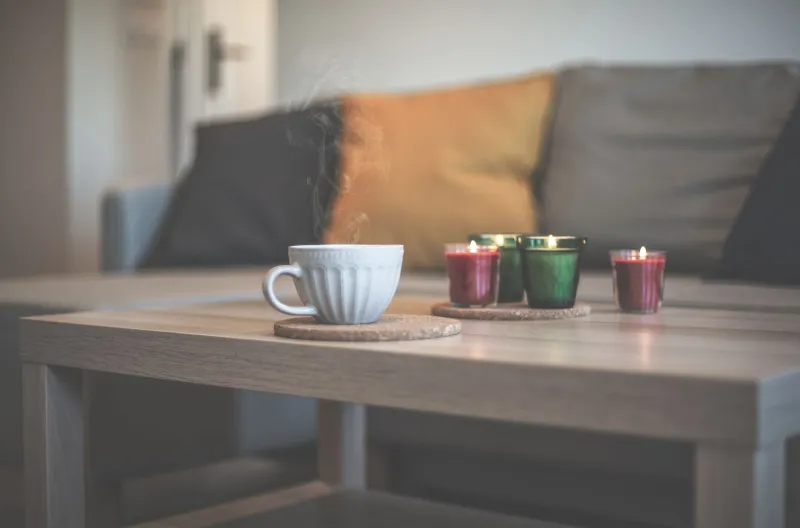
Some evenings need the comfort of a familiar voice. Some mornings need the company of a phone-in you'd never admit to enjoying. And some afternoons, especially the ones that go dark at four, need nothing at all except you, a cup of something hot, and a house that's finally stopped chattering.
You're allowed both. The trick — if there is one — is choosing, rather than simply leaving it on.