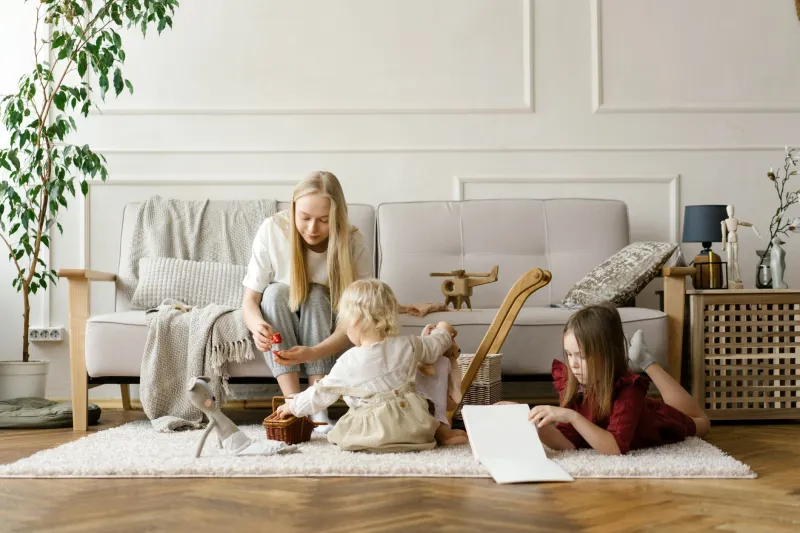
The Light Leaves Early — Let the Evening Land Softly Instead
It's twenty past four on a Tuesday in November, and the sky over the back garden has already gone that flat blue-grey it gets before it gives up entirely. The school run happened in half-light. Tea will happen in the dark. Somewhere in between, the afternoon goes soft and slippy underfoot, and you find yourself standing in the kitchen holding a tea towel you don't remember picking up.
Most households have a name for it. The four o'clock fade. Nothing dramatic — nobody faints — just the quiet sense that the day has stopped being something you're steering and become something that's happening to you.
It's seasonal, not a personal failing
Worth saying plainly, before anything else: this isn't a character flaw. Through early November, sunset across most of Britain lands somewhere around twenty past four, and the stretch from the clocks changing to the solstice is the longest run of the year without a bank holiday in it. Bonfire Night is behind us. The next proper breather is a very long way off.
Light does quiet, constant work in the body — it tells you when to be alert and when to start winding down. When it leaves mid-afternoon, your internal clock gets a slightly confusing message: it's dark, so it must be late. Hence the yawning at half four and the second wind at half nine, when you'd give a lot to be asleep.
You can't argue with the solar system. What you can do is give the evening a soft place to land.
A landing, not another schedule
A landing routine is a different creature from an evening routine. An evening routine is a list of things you do. A landing is the buffer between the racket of the day and the quiet of the night — the bit where you stop, put everything down, and let the day catch up with you.
Four small moves. That's it. If you only manage one on any given night, the whole thing still counts.
Change the light before you change anything else
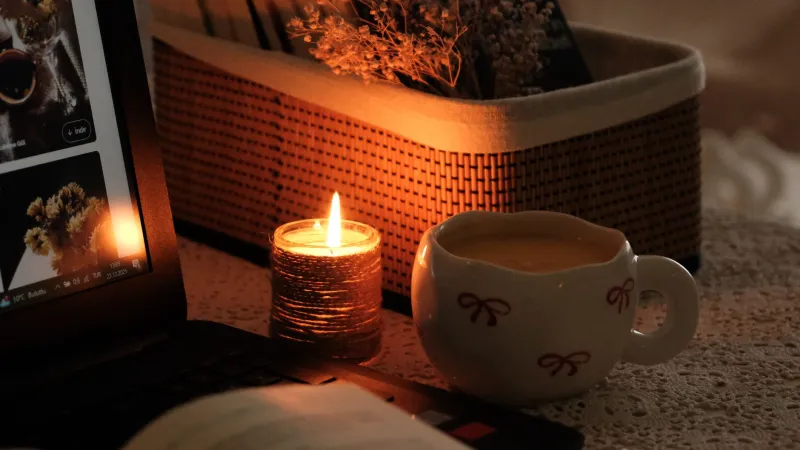
The big light off, the lamps on. Warm bulbs if you have them — the ones that make a room look like a photograph of a room rather than a waiting area. Do it deliberately at around the point the fade normally starts, rather than waiting for the gloom to make the decision for you. Switching a lamp on at a quarter to four is a small kindness to the person you'll be at eight, and it's the whole difference between a house that looks dim and a house that feels low.
Where you can, get outside at lunchtime. Ten minutes counts. Daylight at midday does more for your body clock than a full afternoon under a lamp, and it's cheaper than a SAD lamp too.
Put the kettle on properly
Not a rushed mug between tasks. A proper sit-down drink, made the way you actually like it, in the cup you actually like. If caffeine keeps you up, switch to decaf or something herbal after mid-afternoon — a hot drink at five is really about the warmth and the pause, not the tea itself. On the coldest nights a hot water bottle earns its keep on the sofa, and a blanket on the back of the chair means you don't have to go and find one.
The five-minute reset
Set a timer for five minutes and tidy for the person you'll be at nine o'clock — not for a visitor, and definitely not for an estate agent. Dishes into the rack. Post into one pile. Cushions back on the sofa. Stop when the timer goes, even if there's more to do, because there will always be more to do.
The point isn't a clean house. It's that nine o'clock you doesn't walk into a room that looks like the day is still going on.
A screen curfew that doesn't feel like punishment
Skip the full digital detox — most of us have people to reply to and group chats to keep half an eye on. Go for a taper instead. Half an hour before bed, the phone goes on a shelf across the room, or in a drawer, or face down and out of reach. Swap the scroll for something that asks nothing of you: a few pages of a book, a podcast you've heard before, the radio at low volume.
The first three nights feel odd. By the fifth you'll notice your shoulders are lower.
When your evening doesn't start at six
Plenty of people's doesn't. If you work nights on a ward, in a care home or behind a bar, your landing might be at eleven in the morning with the curtains shut. Parents of babies and toddlers are in a different situation entirely — for them, four o'clock is the start of the difficult shift, not the end of the day, and the idea of a quiet half hour with a herbal tea is somewhere between funny and infuriating.
So take one piece. If all you manage is a lamp and a drink, that is the routine. Anchoring it to the end of your day rather than to the clock on the wall is the whole trick, and a landing routine that has to be performed in a set order at a set time is just another thing to fall behind on.
If it's more than a fade
Seasonal tiredness is ordinary and expected. Low mood that doesn't lift, that drags on past the solstice, or that comes with a loss of interest in things you normally enjoy is worth a conversation with your GP. Talking therapies and light therapy are both available on the NHS, and there is no prize for toughing out a winter.
Small enough to keep
The test of any routine is whether you can still do it on a wet Wednesday when everything has gone sideways. If yours passes that test — one lamp, one drink, five minutes, phone on a shelf — you've built something that will carry you from now until the evenings start stretching out again in February. The light comes back. It always does. In the meantime, let the evening land gently.